As Americans, we know little about patron saints. Maybe we know there's a patron saint of children, or healing, or healing children (St. Jude?). But most of us do not have patron saints of our home towns. Spain has a rich Catholic history. (And Jewish. And Muslim. But why focus on those little details when we can have PATRON SAINTS!!!) So this is where I take you all on a fabulous history of Spain, but only the parts that are relevant to patron saints. As told by Tara (aka Liz's favorite way of learning history).
The Conquista
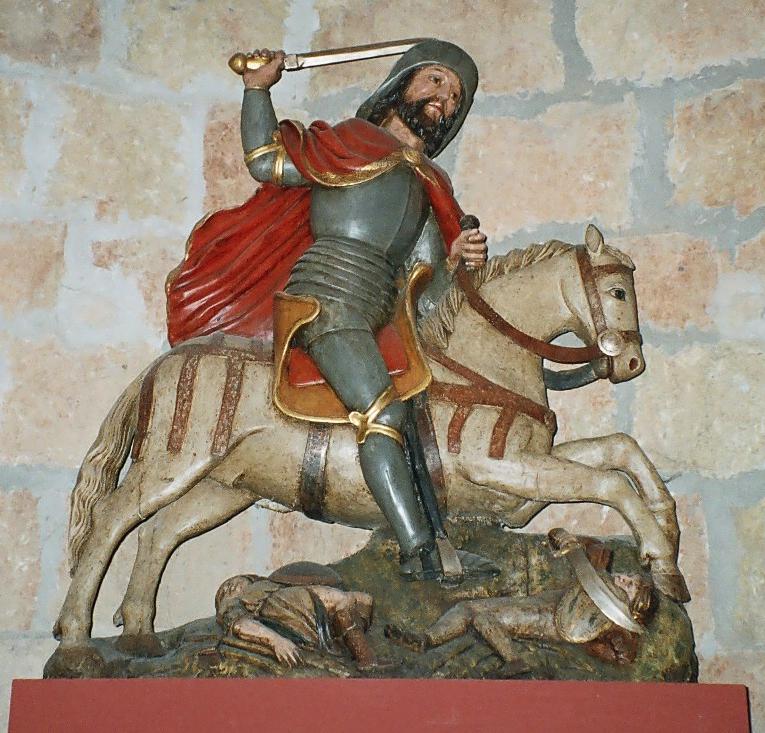
The conquista, or conquest, of Spain by the Arabs began in 711 (kind of funny if you make a connection between the religion of a lot of 7-11 owners. Inappropriate? Sorry, it's how I remember the date). Little by little those moors (I'm translating the Spanish word, not being insensitive) conquested their way up the Iberian Peninsula (but who cares about Portugal?) and almost made their way to the Pyrenees. (Note: If you ask the Basque people, they were the only realm never conquered by the Moors. WOOHOO). But then, one day, somewhere in the northwest of Spain that has more Celtic influence than Spanish, a miracle occurred. Santiago Matamoros (translation: St. James the Moor Killer. We see where this story is going) descended onto Earth from heaven to help the Christian army fight off the dreaded Moors circa 844, in a David and Goliath-type battle, and saved Iberia from complete conquest. Traditionally, this also marks the beginning of the end for the Conquista. Funny, because Arab rule lasted until 1492 (see! another easy date to remember!). In reality, this marks the farthest the Arabs were able to push up north in Iberia and Europe. So yes, the Spaniards credit themselves with saving ALL OF EUROPE from Moorish conquest. Sigh. Needless to say, because Matamoros single saintedly saved Spain from Arab domination ... kind of ... he is the Patron Saint of Spain.
The Christian Kings -- Los Reyes Católicos
But wait! There's more! 1492 was a pretty big year for Spain. Sure, there was that whole discovering America thing, but there was also THE FINAL RECONQUISTA. Queen Isabelle signed a treaty that expelled the Moorish rule from Granada, the last Muslim city in Spain. In return, the Muslims could leave in peace in their own neighborhoods, or Morerías, just as the Christians and Jews had been allowed to live in peace in their own neighborhoods, so long as there was no direct conflict with Islamic law. Isabelle kept up her end of the treaty. Until she forced conversions on the remaining Muslims in Granada. ANYWHO, the Spanish hail Queen Isabelle, and her husband, King Ferdinand, as the Catholic Kings and the final reconquistadors. The marriage of Ferdinand and Isabelle also united the Kingdoms of Aragon and Castille, bringing Spain to the glorious size she is now. (Note: The Basques still maintain they weren't conquered). Well, if you draw some parallels between Ferdinand & Isabelle and Matamoros, you get the trifecta of people who kicked some Muslim tush. Therefore, Matamoros is also the patron saint of Ferdinand and Isabelle's reign, and was so at the time, so any palace occupied by Ferdinand and Isabelle has wonderful statues, paintings, and stained glass like the following:

San Isidro
Saint Isidor the Laborer was a wonderful Madrileño who worked hard and performed a bunch of miracles. At least two of which involved water. And lots of it. But Madrid is a desert in the mountains so this water feat is even more impressive. Needless to say the man from Madrid who could make water appear is the patron saint of Madrid. One of his water miracles included making the water rise in a well after his son fell in and couldn't get it. Up went the water, out came the son. Then he and his wife, also a saint, proclaimed abstinence and went to live in separate houses. Then their son died. I'm not making any glaring generalizations or connections between god punishing their son for their abstinence. But you just did. So, San Isidro, to commemorate your water miracles, on the 15th of May, to commemorate the day of your death, Madrileños go down to el Parque San Isidro, which is right on the lovely / low-lying Manzanares River in Madrid, and have a fabulously drunk picnic. Complete with children in chulapos. And some adults, but the kids are cuter:

Along with the giant tail gate, there are different festivities for the week leading up the holiday, including LOTS OF FIREWORKS. Considering 4th of July will be spent in Spain, I'll take those as my Independence Day Fuegos.
...Which brings me to my last topic for the evening, Puentes.
Puentes
Ah, yes, puentes are wonderful things that help you get from one piece of land to another piece of land when there is water or a huge drop in the middle. Yep, puente means bridge. So what do bridges have to do with Patron Saints? The obvious connection is something about San Isidro and bridges because of all the water he brought to Madrid. Nope. The real answer is the desire to have the most fun as possible.
Instead of observing holidays on a Monday like we do in the States, Spaniards observe the holiday wherever it may fall. When it happens on a weekend, you usually don't get an extra day off school or work, though I suppose in some places they might. On a Monday or a Friday, you get a 3-day weekend. BUT, on a Tuesday or Thursday, FOUR DAY WEEKEND, and the extra day off bridges the gap. Ahhhh it all makes sense now. No one wants to work the Monday between a weekend and a holiday, so why make them. They'd probably ask for the day off, so just let everyone take an extra day off. And this may have something to do with the Spanish economy. Just maybe. If we take out our handy-dandy calendars, we'll see that San Isidro fell on a Tuesday. Which means I got Tuesday off work. And a lot of other people got a four-day weekend to celebrate some water in Madrid, but mostly to drink some wine and sangria and tinto de verano in a giant park.

No comments:
Post a Comment