So, I moved. Some of you read my last post that was essentially me ranting, so then I took it down. I haven't spoken about roommates much because it can be uncomfortable. Especially when you like one and not the other. Diana is Spanish and an absolute sweetheart. Victoria is from Belarus and is not so much a sweetheart. She admits that shes brutally honest with no filter. Going a step further, she has complete disregard for other people's feelings. We had several discussions where I asked her to respect me and treat me as an equal in the house. Eventually, I boiled over and Tuesday I snapped at her. It turned into quite the argument which culminated in her telling me to "get the fuck out of my house." So I did. We had a lot of "misunderstandings" because she says that her thoughts have no logical connection and she says whatever is on her mind. The problem is the context in which things are said makes things offensive. She said I make these logical connections she would never make because I'm a lawyer. She said I'm closed-minded because I'm a lawyer. She said I had an attitude because I'm a lawyer. And I'm a miserable bitch because I'm a lawyer. I finally asked her if she had a bad experience with a lawyer and she said "I'm sure I have I just can't think of any." I asked if lawyers had a bad reputation and she said, "We don't have lawyers in Belarus." And then later in the conversation when I pointed out how her thoughtless acts could lead to injuries she cut me off and said, "And then you'd sue." I said, "No, and then I'd be injured and bleeding." and she rolled her eyes as if it weren't true. Essentially, she didn't like me from the moment I told her I was lawyer. I didn't like her after the first 5 of 6 (yes, I counted) conversations with her were some of the most negative I've ever had in my life.
So I moved across the hall and am living in Lara's room. She moved out yesterday, and I moved in. It was the easiest move of my life because there were no stairs involved, and only 2 suit cases. I'm actually kind of glad because half of my stuff is already packed to go home in 2 weeks. And I'm ready to go home, to get back to my life. I feel that I've gotten all that I can out of my internship and it was a great experience, but I'm ready to take my life off pause and get back to the way things should be.
Gay Pride
Yesterday was Gay Pride in DC and I've never seen such a celebration. There was apparently a parade at some point during the day, but basically the closed down Gran Via, the equivalent of shutting down Broadway in and out of Times Square, and having a giant drinking fest from noon until at least 6 AM. There were several stages set up throughout downtown Madrid that blasted techno music. Stands were set up selling "minis" of beer/sangria (a mini is actually half a liter). Crowds were so deep that at the biggest stage, you were stuck in a crowd from 10 blocks away.
Everyone, whether LGBT or not, used the day as an excuse to party, put on a costume, and wear as little clothing as possible. All of the bars and clubs were so packed that you'd stand outside and dance in the street to the music coming out of the club. Bars even sold minis at their front door so you didn't have to fight the crowd inside to buy drinks. I know that the Spanish know how to party, but this was the most amazing thing I'd ever seen.
What's even more incredible is that nobody was drink and belligerent. I will say this was the first time I've ever seen a Spanish person throw up from drinking too much, but that's what happens when you're 13 hours into drinking, and even then I only saw two girls getting sick. Everyone else was just in a good place enjoying the music and dancing and festivities. No fighting. Just a lot of love.
Normally I get nervous or overwhelmed in big crowds like this but everyone was in such a positive mood that it was infectious.
Sunday, July 1, 2012
Monday, June 18, 2012
English Problems
One of the interesting things about becoming bilingual is language interference. Some people, and by some people I mean Liz, told me that when I studied abroad 3 years ago my English was awful. I spent so much time speaking in Spanish that my syntax and grammar in English paid the price. I think (and hope!) that now my written English isn't as problematic because I still write analytically in English at work and use English in a professional setting. Needless to say I still have times when I say something like "the names of the children" which isn't wrong, but not as common as "the children's names," because in Spanish it's always "los nombres de los niños" and your brain becomes so accustomed to saying it that you have a hard time switching back out.
The other type of English problem is when you forget that someone you're speaking to doesn't speak English as a first language. In Madrid you rarely think someone is fluent in English because few people are. Lara's fiancée and one of her roommates speak English so well that I do forget they're not completely fluent. Sometimes it means explaining a word. Sometimes it means correcting pronunciation. Sometimes it means we know what they're trying to say but we can't think of the word in English. But sometimes things just go wrong. And sometimes we pronounce a word in the other language because it's just funnier that way...but then no one knows if you're being silly or really don't know how to pronounce it.
Yesterday I was talking to one of Lara's roommates in Spanish and I said something about missing my perrita (I do miss Ginger Lee Rogers a whole lot!).
Me: y le dejé a mi perrita!
Roommate: You miss your poopy?
Me: *laugh* puppy?
Roommate: ... puppy.
Me: *laugh* did you mean to say poopy as a joke? Because it's really funny. Or did you mispronounce puppy?
Roommate: I'M NOT A NATIVE SPEAKER! I meant puppy.
And then there were a lot of puppy/poopy jokes.
Or sometimes you see other people make a mistake in their own language and you're glad it's not you...
Coworker1: o tomo vino o me ando por Serrano [either I have a glass of wine or I'll walk myself down Serrano street]
Coworker2: pero por qué meas por la calle? [why are you going to pee on the street?]
1: Cómo? O me tomo vino o me ando por Serrano.[huh? Either I have a class of wine or I'll walk myself down Serrano]
2: Pero por qué meas??? [But why are you peeing?]
1: Me ando ... ooooh! meando! no no no me voy caminando!!!! [I walk myself ... ohhhhhh peeing! no no no I'll go walking!]
Apparently my coworker was misusing the verb andar which means to walk which is always, I walk, not I walk myself. But she said I walk myself which sound the same as the Spanish word for peeing.
In other news, today was Taco Monday which was apparently very exciting. Every now and then the embassy has a special food day, and while the tacos certainly weren't Mexican they were delicious. And a valiente attempt at Mexican food in a country where spicy food doesn't exist and tortilla means omelette.
The other type of English problem is when you forget that someone you're speaking to doesn't speak English as a first language. In Madrid you rarely think someone is fluent in English because few people are. Lara's fiancée and one of her roommates speak English so well that I do forget they're not completely fluent. Sometimes it means explaining a word. Sometimes it means correcting pronunciation. Sometimes it means we know what they're trying to say but we can't think of the word in English. But sometimes things just go wrong. And sometimes we pronounce a word in the other language because it's just funnier that way...but then no one knows if you're being silly or really don't know how to pronounce it.
Yesterday I was talking to one of Lara's roommates in Spanish and I said something about missing my perrita (I do miss Ginger Lee Rogers a whole lot!).
Me: y le dejé a mi perrita!
Roommate: You miss your poopy?
Me: *laugh* puppy?
Roommate: ... puppy.
Me: *laugh* did you mean to say poopy as a joke? Because it's really funny. Or did you mispronounce puppy?
Roommate: I'M NOT A NATIVE SPEAKER! I meant puppy.
And then there were a lot of puppy/poopy jokes.
Or sometimes you see other people make a mistake in their own language and you're glad it's not you...
Coworker1: o tomo vino o me ando por Serrano [either I have a glass of wine or I'll walk myself down Serrano street]
Coworker2: pero por qué meas por la calle? [why are you going to pee on the street?]
1: Cómo? O me tomo vino o me ando por Serrano.[huh? Either I have a class of wine or I'll walk myself down Serrano]
2: Pero por qué meas??? [But why are you peeing?]
1: Me ando ... ooooh! meando! no no no me voy caminando!!!! [I walk myself ... ohhhhhh peeing! no no no I'll go walking!]
Apparently my coworker was misusing the verb andar which means to walk which is always, I walk, not I walk myself. But she said I walk myself which sound the same as the Spanish word for peeing.
In other news, today was Taco Monday which was apparently very exciting. Every now and then the embassy has a special food day, and while the tacos certainly weren't Mexican they were delicious. And a valiente attempt at Mexican food in a country where spicy food doesn't exist and tortilla means omelette.
Saturday, June 16, 2012
Nightlife
When I got back to Madrid I really thought that I wouldn't be able to handle the nightlife here. Not like I did last time. When I was abroad I was rarely out until 6 AM (when you catch the metro home because the metro reopens at 6) but was often out until 4 AM. You fall asleep by 5. If you get 8 hours of sleep you're up at 1 but most likely you're up even later because you were drinking until 4 AM, and then you meet up with friends for lunch. So by the time your day is about to get started is 3 or 4 PM and the day is kind of shot. I told myself I couldn't handle that lifestyle anymore because I'm "old," and mature ... or something.
I was wrong.
I woke up this morning around 9 AM and realized it was the first weekend since I got to Spain that I had a full night's rest and was up early in the morning to do things I needed to do before starting my day. So this morning I've cleaned my room, the rest of my apartment, did a load of laundry, and made food for the week, all before 11 AM. And I feel great. It's also because I fell asleep at 11 PM with the lights on, watching tv on my computer.
For the last few weekends I've been out until 4 or 5 every Friday or Saturday. I think part of the issue is that it's light out until after 10 PM (which I always thought was a myth and an exaggeration ... but it's not) so it doesn't feel like dinner time until 11 PM so you eat at 11 or 11:30 and go out to bars at 1 AM. In DC, I'm often on my way home at 1 AM. And then drinks are extremely strong. And we're up in the mountains. So then you've had more to drink than you intended and it's almost 5 o'clock in the morning before you even feel tired. I thought that I was adapting well to the Spanish lifestyle, except being so accomplished this morning makes me realize how awful I feel waking up in the afternoon and doing nothing with my day except eating lunch and resting before starting the Spanish nightlife all over again. I can see how this would have been great in high school when I slept all day anyway, but now I just feel bad about myself. I waste my life away when I could be doing other things. Like cleaning.
So fret not, friends, when I come home I won't be partying until 5 AM (unless it's my birthday... 3/16/2012. Sammy and I are already planning) and I'll still be waking up bright eyed and bushy tailed to start my day. And texting you way earlier than you like because I don't realize that other people sleep in (Sorry Sammy).
I was wrong.
I woke up this morning around 9 AM and realized it was the first weekend since I got to Spain that I had a full night's rest and was up early in the morning to do things I needed to do before starting my day. So this morning I've cleaned my room, the rest of my apartment, did a load of laundry, and made food for the week, all before 11 AM. And I feel great. It's also because I fell asleep at 11 PM with the lights on, watching tv on my computer.
For the last few weekends I've been out until 4 or 5 every Friday or Saturday. I think part of the issue is that it's light out until after 10 PM (which I always thought was a myth and an exaggeration ... but it's not) so it doesn't feel like dinner time until 11 PM so you eat at 11 or 11:30 and go out to bars at 1 AM. In DC, I'm often on my way home at 1 AM. And then drinks are extremely strong. And we're up in the mountains. So then you've had more to drink than you intended and it's almost 5 o'clock in the morning before you even feel tired. I thought that I was adapting well to the Spanish lifestyle, except being so accomplished this morning makes me realize how awful I feel waking up in the afternoon and doing nothing with my day except eating lunch and resting before starting the Spanish nightlife all over again. I can see how this would have been great in high school when I slept all day anyway, but now I just feel bad about myself. I waste my life away when I could be doing other things. Like cleaning.
So fret not, friends, when I come home I won't be partying until 5 AM (unless it's my birthday... 3/16/2012. Sammy and I are already planning) and I'll still be waking up bright eyed and bushy tailed to start my day. And texting you way earlier than you like because I don't realize that other people sleep in (Sorry Sammy).
Sunday, June 10, 2012
Hodge Podge
Looking Back
My time in Madrid is half done. Part of me thinks, "Already???" and the other part thinks it feels like I've been here forever. I think part of that has to do with feeling like I picked up where I left off four years ago. I'm going to some of the same places with some of the same people, or same places with new people, and new places with new people. It just feels like my life has continued on from June 2009 and picked up in May 2012.
The good part about retracing my steps is that I've been able to see how much I have (not) changed in the last three years. I've noticed how much growing up I've done and have reflected on all the experiences I hadn't had yet that have given me my personality and my outlook on life. In a lot of ways I feel wiser than I was before, and I don't mean that I'm all-knowing, but the last three years I've started living on my own, graduated college, got rejected from 100s of jobs, started law school, got rejected from 100s more jobs, made friends, lost friends, had two knee surgeries, and adopted Ginger Lee Rogers. All of these events, big or small, have changed me from who I was in 2009. A few nights ago I was talking with one of the Marines who works at the Embassy and we were talking about thoughts on a variety of subjects, most of them serious. We're the same age and had a lot of the same experiences that we've grown and matured from. What struck me was when he asked me what it's like to live on my own. Taking the steps of living with family to a sheltered dorm environment to living with a host family to living in a house with 4 other women and finally living on my own, there was a progression in my life of learning how to live on my own with less security every step of the way. He thought it would be weird to live on his own, and I realized that even though he's been responsible for the safety of other people for the last 6 years, he's never been responsible for paying his own bills. It's such a mundane task, and I think you take for granted that by 25 you learn how to live on your own as an adult, but he'll be 25, living on his on for the first time, having never had to remember to pay bills or go grocery shopping. It also made me realize that 3 years ago I hadn't done any of that either, but now it's second nature and just part of life that I don't even think about.
Trips
So far I've taken two day trips, one to Avila, and today I went hiking.
OK, let's start with the more surprising of those two: I went hiking. I'm from NYC. The outdoors is a great but scary place filled with bugs and mud and ways to hurt yourself. One of my coworkers invited me on a day hike and I said sure. One, because I didn't actually know if I liked hiking or not (turns out I do). Two, because I thought it would be a good (or awful) test for my knee. And three, when else am I going to get the chance to go hiking in Spain. We went to a small town called Rascafria (wow, that's the worst Wiki article I've ever seen) and hiked in Peñalara Natural Park. We went on a 6K hike, most of which wasn't too treacherous, but some of it was a little challenging. One of the things I love about Spain is how quickly weather changes in the mountains. When we got to the park it was cold and rainy and I thought I was poorly dressed in a T-shirt and shorts. We went into a monastery for a few minutes, and when we came out it was sunny and warming up. Throughout the day we had overcast skies, cloudy skies, partly cloudy skies, drizzle, rain, sunshine. I was really worried about my knee as we got to some of the bigger rocks but I think was all in my head, and I made it to the grand finale, the Cascada de Pergutorio (Waterfall of Pergutory ... yikes) no problem
I never think of the Spanish as an outdoor-loving people unless it involves a combination of soccer, beer, and a stroll in the park. In the year I lived here I never heard anyone talk about hiking or outdoor adventures, so I was surprised to see how many people we on the trail with us. I was also surprised to see that animals were being herded and kept in different pens along the mountain (mostly cows). And looking back on it, I didn't see any litter which is what you expect when you climb a mountain, but there tends to be a lot of litter in Spain, and people just drop things on the floor instead of looking for a trash can, so it was nice to see that park kept so nice.
On Memorial Day, I took a day trip to Avila which is home to lots of medieval churches (including one that started being built around 350 AD but is mostly medieval in style) and a giant wall to keep people out. And my people I probably mean Moors. I went on a Monday which meant that most of the museums were closed which made my trip a lot shorter than initially planned. One of the disappointing things about seeing a small medieval town is once you've seen one you've kind of seen them all. The main attractions are churches and cathedrals and churches and an architectural phenomenon or two. So nothing struck me in Avila the way things struck me in Segovia or Toledo or the small towns we went to in Extremadura or Castilla-Leon or Castilla-La-Mancha.
EuroCup
Europeans say that Americans are way too patriotic and everyone has an American flag and we go around singing the national anthem all day long. OK, maybe not the last part. But they do think we're the most patriotic country in the world.
Until now.
The EuroCup is a regionalsoccer fútbol tournament with 16 teams competing every four years to be crowned the champions of Europe. Spain won the EuroCup in 2008, and the World Cup in 2010, so the country is really excited right now. Everyone has Spanish flags hanging off their balconies, they're all walking around in Spanish National Team jerseys, and people are glued to their TVs. Leaving Rascafria today we saw a group of ~10 Spanish children draped in the nation's flag, faces painted red and yellow, with whistles and noiseblowers and egging on passing cars to honk. Any other time of year these small children would be labelled Franco-loving facists, but when it's all in support of Spanish soccer, it's adorable and priased.
Anyway, the teams are split up into 4 pools, the top 2 from each pool after round play goes on to the following round, similar to the World Cup. Sorry Spain, you tied Italy 1-1 and played a much better game. Better luck against Ireland and Croatia.
As often happens, there's a lot of politics involved in this match. It's not quite the Miracle on Ice or the Berlin Olympics, but it is an important time for Europe. There's still a lot of inequality between Western and Eastern European countries, and Eastern Europe is still viewed by Western Europe as underdeveloped and backwards. In an attempt to debunk some of those myths, UEFA awarded the EuroCup to be played in Poland and the Ukraine, most likely because neither of those countries could handle all those games, but they can show the rest of Europe that they are a cultured, smart people with a lot to offer the EU (Poland is an EU member, the Ukraine is not, though presumably is trying to become a candidate country). Western Europe tends to see Eastern Europe as pulling down the Euro and the European economy as a whole, so this is a good chance to A. help the economy but B. show what these countries have to offer. But that only works IF these countries can present a positive front. (note: of the 16 teams the 5 Eastern European teams are Russia, Poland, Ukraine, Croatia, and the Czech Republic).
There are current and former soccer stars who are boycotting the games because of the rampant racism -- mostly against Muslims, Jews, and Africans -- in Poland and the Ukraine. The players have been training in the two countries for a few weeks and many were bombarded with racial slurs during practices, including a group of Polish men raising their arms and heiling Hitler to some Jewish players, and a group of South Asian youths who were beaten during a game for no reason other than being South Asian. With acts like that, the EU member states are only going to continue looking down on Poland and the Ukraine. I was reading an article that criticized UEFA for giving the bid to Poland and the Ukraine to help improve the impression that the west has about the east, and said that the games should have been awarded as a reward for making certain steps to stopping racism and other social problems, not given out in hopes that the countries would magically become more tolerant.
According to these articles, racism seems to be an issue, and it's only day 3:
http://www.bbc.co.uk/sport/0/football/18383678
http://www.bbc.co.uk/sport/0/football/18338838
http://www.bbc.co.uk/sport/0/football/18377957
My time in Madrid is half done. Part of me thinks, "Already???" and the other part thinks it feels like I've been here forever. I think part of that has to do with feeling like I picked up where I left off four years ago. I'm going to some of the same places with some of the same people, or same places with new people, and new places with new people. It just feels like my life has continued on from June 2009 and picked up in May 2012.
The good part about retracing my steps is that I've been able to see how much I have (not) changed in the last three years. I've noticed how much growing up I've done and have reflected on all the experiences I hadn't had yet that have given me my personality and my outlook on life. In a lot of ways I feel wiser than I was before, and I don't mean that I'm all-knowing, but the last three years I've started living on my own, graduated college, got rejected from 100s of jobs, started law school, got rejected from 100s more jobs, made friends, lost friends, had two knee surgeries, and adopted Ginger Lee Rogers. All of these events, big or small, have changed me from who I was in 2009. A few nights ago I was talking with one of the Marines who works at the Embassy and we were talking about thoughts on a variety of subjects, most of them serious. We're the same age and had a lot of the same experiences that we've grown and matured from. What struck me was when he asked me what it's like to live on my own. Taking the steps of living with family to a sheltered dorm environment to living with a host family to living in a house with 4 other women and finally living on my own, there was a progression in my life of learning how to live on my own with less security every step of the way. He thought it would be weird to live on his own, and I realized that even though he's been responsible for the safety of other people for the last 6 years, he's never been responsible for paying his own bills. It's such a mundane task, and I think you take for granted that by 25 you learn how to live on your own as an adult, but he'll be 25, living on his on for the first time, having never had to remember to pay bills or go grocery shopping. It also made me realize that 3 years ago I hadn't done any of that either, but now it's second nature and just part of life that I don't even think about.
Trips
So far I've taken two day trips, one to Avila, and today I went hiking.
OK, let's start with the more surprising of those two: I went hiking. I'm from NYC. The outdoors is a great but scary place filled with bugs and mud and ways to hurt yourself. One of my coworkers invited me on a day hike and I said sure. One, because I didn't actually know if I liked hiking or not (turns out I do). Two, because I thought it would be a good (or awful) test for my knee. And three, when else am I going to get the chance to go hiking in Spain. We went to a small town called Rascafria (wow, that's the worst Wiki article I've ever seen) and hiked in Peñalara Natural Park. We went on a 6K hike, most of which wasn't too treacherous, but some of it was a little challenging. One of the things I love about Spain is how quickly weather changes in the mountains. When we got to the park it was cold and rainy and I thought I was poorly dressed in a T-shirt and shorts. We went into a monastery for a few minutes, and when we came out it was sunny and warming up. Throughout the day we had overcast skies, cloudy skies, partly cloudy skies, drizzle, rain, sunshine. I was really worried about my knee as we got to some of the bigger rocks but I think was all in my head, and I made it to the grand finale, the Cascada de Pergutorio (Waterfall of Pergutory ... yikes) no problem
I never think of the Spanish as an outdoor-loving people unless it involves a combination of soccer, beer, and a stroll in the park. In the year I lived here I never heard anyone talk about hiking or outdoor adventures, so I was surprised to see how many people we on the trail with us. I was also surprised to see that animals were being herded and kept in different pens along the mountain (mostly cows). And looking back on it, I didn't see any litter which is what you expect when you climb a mountain, but there tends to be a lot of litter in Spain, and people just drop things on the floor instead of looking for a trash can, so it was nice to see that park kept so nice.
On Memorial Day, I took a day trip to Avila which is home to lots of medieval churches (including one that started being built around 350 AD but is mostly medieval in style) and a giant wall to keep people out. And my people I probably mean Moors. I went on a Monday which meant that most of the museums were closed which made my trip a lot shorter than initially planned. One of the disappointing things about seeing a small medieval town is once you've seen one you've kind of seen them all. The main attractions are churches and cathedrals and churches and an architectural phenomenon or two. So nothing struck me in Avila the way things struck me in Segovia or Toledo or the small towns we went to in Extremadura or Castilla-Leon or Castilla-La-Mancha.
Cathedral
Lion outside of the main church. Lions are the main symbol of the royal family descending from Castilla León and why the Lion is on the Spanish crest.
Anti-invader wall
Europeans say that Americans are way too patriotic and everyone has an American flag and we go around singing the national anthem all day long. OK, maybe not the last part. But they do think we're the most patriotic country in the world.
Until now.
The EuroCup is a regional
Anyway, the teams are split up into 4 pools, the top 2 from each pool after round play goes on to the following round, similar to the World Cup. Sorry Spain, you tied Italy 1-1 and played a much better game. Better luck against Ireland and Croatia.
As often happens, there's a lot of politics involved in this match. It's not quite the Miracle on Ice or the Berlin Olympics, but it is an important time for Europe. There's still a lot of inequality between Western and Eastern European countries, and Eastern Europe is still viewed by Western Europe as underdeveloped and backwards. In an attempt to debunk some of those myths, UEFA awarded the EuroCup to be played in Poland and the Ukraine, most likely because neither of those countries could handle all those games, but they can show the rest of Europe that they are a cultured, smart people with a lot to offer the EU (Poland is an EU member, the Ukraine is not, though presumably is trying to become a candidate country). Western Europe tends to see Eastern Europe as pulling down the Euro and the European economy as a whole, so this is a good chance to A. help the economy but B. show what these countries have to offer. But that only works IF these countries can present a positive front. (note: of the 16 teams the 5 Eastern European teams are Russia, Poland, Ukraine, Croatia, and the Czech Republic).
There are current and former soccer stars who are boycotting the games because of the rampant racism -- mostly against Muslims, Jews, and Africans -- in Poland and the Ukraine. The players have been training in the two countries for a few weeks and many were bombarded with racial slurs during practices, including a group of Polish men raising their arms and heiling Hitler to some Jewish players, and a group of South Asian youths who were beaten during a game for no reason other than being South Asian. With acts like that, the EU member states are only going to continue looking down on Poland and the Ukraine. I was reading an article that criticized UEFA for giving the bid to Poland and the Ukraine to help improve the impression that the west has about the east, and said that the games should have been awarded as a reward for making certain steps to stopping racism and other social problems, not given out in hopes that the countries would magically become more tolerant.
According to these articles, racism seems to be an issue, and it's only day 3:
http://www.bbc.co.uk/sport/0/football/18383678
http://www.bbc.co.uk/sport/0/football/18338838
http://www.bbc.co.uk/sport/0/football/18377957
Friday, June 1, 2012
Official Visits
This all happened last week but for some reason I was exceedingly remiss on writing my thoughts about it. Maybe because I thought so much about it.
Florida's First Lady
The Governor of Florida, Rick Scott, and the First Lady, Ann Scott, came to Madrid last week to try to improve economic relations between Spain and Florida. I thought this was odd because I didn't realize that states could enter into agreements or negotiations with countries, and it turns out that they don't produce treaties, but can produce policies and agreements.
For Spanish media, this was the highlight of the trip:
If you're not sure what Gov. Scott is referencing, the King of Spain, Juan Carlos I, went on a Safari and was photographed hunting elephants. Spaniards were so upset that JCI publicly apologized, the first time a Spanish King has ever done that. Ever.
Lucky for me I did't know about that little jab.
So I spent the day with Mrs. Scott going to the American School of Madrid (it made me want to go back to high school) and a bilingual public middle school in Spain. As someone who once applied to M.A.T. programs to become a teacher, it was a really interesting day. Mrs. Scott's causes are education and literacy which is why she wanted to tour schools in Madrid while she was here, as she often does in Florida.
The best part of the day had to be going on a tour of the Palacio Real (Royal Palace) with her and getting to go behind those pesky ropes that keep people out of certain areas, and we even got a tour of parts of the palace that are not opened to the public because they're used by the Royal Family for entertaining special guests. I couldn't take any pictures inside the palace, but even the court yard is gorgeous.
The Ambassador
The Ambassador makes an effort to get to know as much of his staff as possible, which means monthly coffees with 15-20 employees -- both American and local. In the summer he prioritizes temp-hires and students so he can meet with them before they go, but mixes it in with people who have been there for 20+ years. It gives you a good idea of where your coworkers come from and where they learned English or Spanish and what it's been like to move so often, etc. Mr. and Mrs. Solomont also gave their views on living in Spain and a brief summary of their lives, and it made them much more approachable. I didn't expect the Ambassador to take time out of his day to get to know the people who support his mission but I was glad to see that he does. Not to mention their dog is ADORABLE.
Florida's First Lady
The Governor of Florida, Rick Scott, and the First Lady, Ann Scott, came to Madrid last week to try to improve economic relations between Spain and Florida. I thought this was odd because I didn't realize that states could enter into agreements or negotiations with countries, and it turns out that they don't produce treaties, but can produce policies and agreements.
For Spanish media, this was the highlight of the trip:
If you're not sure what Gov. Scott is referencing, the King of Spain, Juan Carlos I, went on a Safari and was photographed hunting elephants. Spaniards were so upset that JCI publicly apologized, the first time a Spanish King has ever done that. Ever.
Lucky for me I did't know about that little jab.
So I spent the day with Mrs. Scott going to the American School of Madrid (it made me want to go back to high school) and a bilingual public middle school in Spain. As someone who once applied to M.A.T. programs to become a teacher, it was a really interesting day. Mrs. Scott's causes are education and literacy which is why she wanted to tour schools in Madrid while she was here, as she often does in Florida.
The best part of the day had to be going on a tour of the Palacio Real (Royal Palace) with her and getting to go behind those pesky ropes that keep people out of certain areas, and we even got a tour of parts of the palace that are not opened to the public because they're used by the Royal Family for entertaining special guests. I couldn't take any pictures inside the palace, but even the court yard is gorgeous.
The Ambassador
The Ambassador makes an effort to get to know as much of his staff as possible, which means monthly coffees with 15-20 employees -- both American and local. In the summer he prioritizes temp-hires and students so he can meet with them before they go, but mixes it in with people who have been there for 20+ years. It gives you a good idea of where your coworkers come from and where they learned English or Spanish and what it's been like to move so often, etc. Mr. and Mrs. Solomont also gave their views on living in Spain and a brief summary of their lives, and it made them much more approachable. I didn't expect the Ambassador to take time out of his day to get to know the people who support his mission but I was glad to see that he does. Not to mention their dog is ADORABLE.
Friday, May 25, 2012
Change of tune
So I realized that I've been negative or critical about a lot of things. The fact is that it's easier to criticize something that's different than to embrace it. I think it's more of a coping mechanism. At some point this week I realized how negative I've been, and started to make a list of all the thigns I lvoe about Madrid besides the care-free lifestyle, cheap booze, and endless nightlife.
Alimentación
Literally alimentación means food or nourishment, but they're produce stands/convenience stores that are all over Madrid, and most other parts of Spain. They sell almost anything you could want from fruits and vegetables to litronas (40s) and bricks (boxes of wine) to snacks and milk. Somehow I hardly pass any on my walk from home to work, probably because the majority of my walk is through pijo neighborhoods. But it makes it so easy to stop on the way home to pick up fresh fruit or vegetables, which is something I really miss about New York. In DC I have to go out of my way to pass any type of grocery store on my way home and even then the produce isn't always fresh. But here I stop and pick up a tomato (tomate), zucchini (calabacin), or avocado (aguacate) on my way home from work on a daily basis and never have to worry about what coordinating my route home to make sure I can stop at the store. My closest alimentación is next door to my apartment and it's really spoiling me. Not to mention alimentaciones, unlike grocery stores, are open on Sunday which means whatever you need for your Sunday brunch you can still buy. And if you're lucky, your alimentación sells fresh pan.
Metro
Sure, NY, DC, and Boston all have subway systems, but the Madrid metro is clean and efficient. It was a gift to Spain -- let's call a spade a spade, it was a dowry gift from Great Britain when Victoria of Battenberg married then-Prince and future-King Alfonso XIII of Spain. (Actually, they have a lovely wedding story. They married in Madrid in 1906 when anarchists were alive and well in Europe. An ancarchist attempted to assassinate the couple during their wedding but threw a bomb that somehow bounced off of phone lines and whatever else the bomb could hit so it missed the Royals. The bomb succeeded in killing some visitors and Victoria's dress was stained with blood. Everytime I pass by the site of the assassination attempt all I can envision is absolute mayhem but Victoria crying about her dress. That may not be true, but it's how I see it.) This is also why the Madrid metro runs on the "wrong" side of the track. So while cars drive on the right side of the road, the metro drives on the left. It takes a while to get used to.
Anyway, the metro is clean, and during rush hour you never wait more than 2 or 3 minutes for a train. Compare this with waiting 6 or 7 minutes for either a blue or orange train to come, so 10 - 15 minutes if you need a specific train. OK, first world complaints, but still much appreciated. Thank you, Great Britain, for your generous contribution. But thank you more, Madrid, for keeping the metro in good condition.
Respect for History
Europeans never stop reminding me that U.S. history is nothing compared to European history. Their memories reach far back and hold on to a lot of the past. One really great thing about this is the maintenace of old architecture. In the U.S. we have a tendency to tear down buildings and erect bigger ones in their place. Madrid, however, is more like D.C. in that there are newer parts of town, but in the older sections (|| Capitol Hill) buildings are preserved and converted into something else, but the façade stays the same. And plaques are put up to remind people why that building or site is important. It's really incredible to walk around Madrid and see the old buildings where so-and-so lived converted into retail shops and apartment buildings, or a hotel, but by the outside you'd never know that anything had changed in the last hundred years. I actually took this for granted until someone mentioned it to me and I realized that it could be a huge economic investment to demolish and rebuild the city, but out of respect for the historical value of the city, they only invest in internal renovations, if that.
Alimentación
Literally alimentación means food or nourishment, but they're produce stands/convenience stores that are all over Madrid, and most other parts of Spain. They sell almost anything you could want from fruits and vegetables to litronas (40s) and bricks (boxes of wine) to snacks and milk. Somehow I hardly pass any on my walk from home to work, probably because the majority of my walk is through pijo neighborhoods. But it makes it so easy to stop on the way home to pick up fresh fruit or vegetables, which is something I really miss about New York. In DC I have to go out of my way to pass any type of grocery store on my way home and even then the produce isn't always fresh. But here I stop and pick up a tomato (tomate), zucchini (calabacin), or avocado (aguacate) on my way home from work on a daily basis and never have to worry about what coordinating my route home to make sure I can stop at the store. My closest alimentación is next door to my apartment and it's really spoiling me. Not to mention alimentaciones, unlike grocery stores, are open on Sunday which means whatever you need for your Sunday brunch you can still buy. And if you're lucky, your alimentación sells fresh pan.
Metro
Sure, NY, DC, and Boston all have subway systems, but the Madrid metro is clean and efficient. It was a gift to Spain -- let's call a spade a spade, it was a dowry gift from Great Britain when Victoria of Battenberg married then-Prince and future-King Alfonso XIII of Spain. (Actually, they have a lovely wedding story. They married in Madrid in 1906 when anarchists were alive and well in Europe. An ancarchist attempted to assassinate the couple during their wedding but threw a bomb that somehow bounced off of phone lines and whatever else the bomb could hit so it missed the Royals. The bomb succeeded in killing some visitors and Victoria's dress was stained with blood. Everytime I pass by the site of the assassination attempt all I can envision is absolute mayhem but Victoria crying about her dress. That may not be true, but it's how I see it.) This is also why the Madrid metro runs on the "wrong" side of the track. So while cars drive on the right side of the road, the metro drives on the left. It takes a while to get used to.
Anyway, the metro is clean, and during rush hour you never wait more than 2 or 3 minutes for a train. Compare this with waiting 6 or 7 minutes for either a blue or orange train to come, so 10 - 15 minutes if you need a specific train. OK, first world complaints, but still much appreciated. Thank you, Great Britain, for your generous contribution. But thank you more, Madrid, for keeping the metro in good condition.
Respect for History
Europeans never stop reminding me that U.S. history is nothing compared to European history. Their memories reach far back and hold on to a lot of the past. One really great thing about this is the maintenace of old architecture. In the U.S. we have a tendency to tear down buildings and erect bigger ones in their place. Madrid, however, is more like D.C. in that there are newer parts of town, but in the older sections (|| Capitol Hill) buildings are preserved and converted into something else, but the façade stays the same. And plaques are put up to remind people why that building or site is important. It's really incredible to walk around Madrid and see the old buildings where so-and-so lived converted into retail shops and apartment buildings, or a hotel, but by the outside you'd never know that anything had changed in the last hundred years. I actually took this for granted until someone mentioned it to me and I realized that it could be a huge economic investment to demolish and rebuild the city, but out of respect for the historical value of the city, they only invest in internal renovations, if that.
Wednesday, May 23, 2012
The Euro
When you want to buy something, and you check the price and it seems a little steep and THEN you realize it's in Euros, not Dollars:
Although with the current economic situation, we may be back at evens soon.
Sunday, May 20, 2012
The rain in Spain falls mainly on...
The plains.
When I was little, I misunderstood which kind of plains we were talking about it, and thought the rain in Spain falls mainly on the planes. Because they're high up in the air and the rain never quite made it down to the ground so it fell mainly on the planes. I had a lot of interesting thoughts like this. And then I thought this rhyme existed merely because it rhymes.
Turns out, it's true. The rain in Spain does fall mainly on the plains. There's also a Spanish version of this rhyme which is similar and wasn't used in My Fair Lady. The northern and southern parts of Spain get significantly more than the mountain area of Madrid does. So much so that Madrid is technically a desert, and I'm not sure how there's so much greenery here so if anyone knows please tell me.
Living in Madrid for a year I didn't think it rained that much and can only think of a few days when I needed an umbrella. Madrileños love when it rains because it's so rare. Coming from Tufts where it rained non-stop in the Spring, I didn't mind dryer weather. DC hasn't been particularly rainy since I moved down, so I don't mind the rain in Madrid as much now as I did a few years ago.
For the last two days, it's been raining in Madrid. For the first time I've heard thunder in Madrid, and huge cracks of thunder that echo across the mountains. The skies turn this marvelous dark grey-purple. But days are never rainy or grey, which means even though it's raining on you (but never pouring) you can always look to the east or west and see sunshine.
With the luck that Lara and I have, we got caught in one of the two patches of rain yesterday. It started as we exited the metro and ended as we got to her boyfriend's apartment. Que suerte. I wish I had taken a picture of the sky after because it looked fake. There was a swirl of dark clouds in the center of our view, but to the left and right it was perfectly sunny. I think this might be a typical rain patterm for mountainous Spain. Although not Madrid, these were taken a few years ago in Granada at Al Alhambra. It was snowing in the shadowed areas and sunny in ... the sun.
Knowing that it was supposed to be a rainy weekend in Madrid, I woke up this morning and checked the weather. Partly cloudy. No chance of rain. So I decided to do a load of laundry. 20 minutes after I hung the laundry to dry, it started drizzling. Que suerte. Oh well, the clothes just stay on the line and will eventually dry if the weight of the water doesn't make my laundry fall down 4 stories. So now I'm sitting in Lara's apartment, and hear the thunder cracks, and realize that maybe now would be a good time to take in my laundry. Well just imagine that for the first time in a while I timed it perfectly and took in my laundry and as I took my last T-shirt off the line, the heavens opened up. Maybe my luck isn't all bad after all.
When I was little, I misunderstood which kind of plains we were talking about it, and thought the rain in Spain falls mainly on the planes. Because they're high up in the air and the rain never quite made it down to the ground so it fell mainly on the planes. I had a lot of interesting thoughts like this. And then I thought this rhyme existed merely because it rhymes.
Turns out, it's true. The rain in Spain does fall mainly on the plains. There's also a Spanish version of this rhyme which is similar and wasn't used in My Fair Lady. The northern and southern parts of Spain get significantly more than the mountain area of Madrid does. So much so that Madrid is technically a desert, and I'm not sure how there's so much greenery here so if anyone knows please tell me.
Living in Madrid for a year I didn't think it rained that much and can only think of a few days when I needed an umbrella. Madrileños love when it rains because it's so rare. Coming from Tufts where it rained non-stop in the Spring, I didn't mind dryer weather. DC hasn't been particularly rainy since I moved down, so I don't mind the rain in Madrid as much now as I did a few years ago.
For the last two days, it's been raining in Madrid. For the first time I've heard thunder in Madrid, and huge cracks of thunder that echo across the mountains. The skies turn this marvelous dark grey-purple. But days are never rainy or grey, which means even though it's raining on you (but never pouring) you can always look to the east or west and see sunshine.
With the luck that Lara and I have, we got caught in one of the two patches of rain yesterday. It started as we exited the metro and ended as we got to her boyfriend's apartment. Que suerte. I wish I had taken a picture of the sky after because it looked fake. There was a swirl of dark clouds in the center of our view, but to the left and right it was perfectly sunny. I think this might be a typical rain patterm for mountainous Spain. Although not Madrid, these were taken a few years ago in Granada at Al Alhambra. It was snowing in the shadowed areas and sunny in ... the sun.
Knowing that it was supposed to be a rainy weekend in Madrid, I woke up this morning and checked the weather. Partly cloudy. No chance of rain. So I decided to do a load of laundry. 20 minutes after I hung the laundry to dry, it started drizzling. Que suerte. Oh well, the clothes just stay on the line and will eventually dry if the weight of the water doesn't make my laundry fall down 4 stories. So now I'm sitting in Lara's apartment, and hear the thunder cracks, and realize that maybe now would be a good time to take in my laundry. Well just imagine that for the first time in a while I timed it perfectly and took in my laundry and as I took my last T-shirt off the line, the heavens opened up. Maybe my luck isn't all bad after all.
Thursday, May 17, 2012
Patron Saints and Puentes
Patron Saints
As Americans, we know little about patron saints. Maybe we know there's a patron saint of children, or healing, or healing children (St. Jude?). But most of us do not have patron saints of our home towns. Spain has a rich Catholic history. (And Jewish. And Muslim. But why focus on those little details when we can have PATRON SAINTS!!!) So this is where I take you all on a fabulous history of Spain, but only the parts that are relevant to patron saints. As told by Tara (aka Liz's favorite way of learning history).
The Conquista
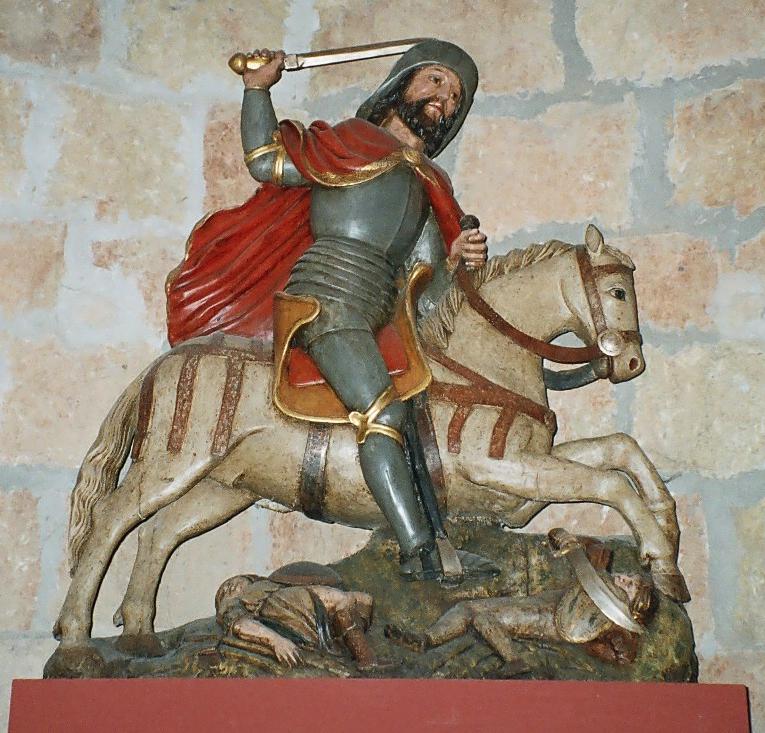
The conquista, or conquest, of Spain by the Arabs began in 711 (kind of funny if you make a connection between the religion of a lot of 7-11 owners. Inappropriate? Sorry, it's how I remember the date). Little by little those moors (I'm translating the Spanish word, not being insensitive) conquested their way up the Iberian Peninsula (but who cares about Portugal?) and almost made their way to the Pyrenees. (Note: If you ask the Basque people, they were the only realm never conquered by the Moors. WOOHOO). But then, one day, somewhere in the northwest of Spain that has more Celtic influence than Spanish, a miracle occurred. Santiago Matamoros (translation: St. James the Moor Killer. We see where this story is going) descended onto Earth from heaven to help the Christian army fight off the dreaded Moors circa 844, in a David and Goliath-type battle, and saved Iberia from complete conquest. Traditionally, this also marks the beginning of the end for the Conquista. Funny, because Arab rule lasted until 1492 (see! another easy date to remember!). In reality, this marks the farthest the Arabs were able to push up north in Iberia and Europe. So yes, the Spaniards credit themselves with saving ALL OF EUROPE from Moorish conquest. Sigh. Needless to say, because Matamoros single saintedly saved Spain from Arab domination ... kind of ... he is the Patron Saint of Spain.
The Christian Kings -- Los Reyes Católicos
But wait! There's more! 1492 was a pretty big year for Spain. Sure, there was that whole discovering America thing, but there was also THE FINAL RECONQUISTA. Queen Isabelle signed a treaty that expelled the Moorish rule from Granada, the last Muslim city in Spain. In return, the Muslims could leave in peace in their own neighborhoods, or Morerías, just as the Christians and Jews had been allowed to live in peace in their own neighborhoods, so long as there was no direct conflict with Islamic law. Isabelle kept up her end of the treaty. Until she forced conversions on the remaining Muslims in Granada. ANYWHO, the Spanish hail Queen Isabelle, and her husband, King Ferdinand, as the Catholic Kings and the final reconquistadors. The marriage of Ferdinand and Isabelle also united the Kingdoms of Aragon and Castille, bringing Spain to the glorious size she is now. (Note: The Basques still maintain they weren't conquered). Well, if you draw some parallels between Ferdinand & Isabelle and Matamoros, you get the trifecta of people who kicked some Muslim tush. Therefore, Matamoros is also the patron saint of Ferdinand and Isabelle's reign, and was so at the time, so any palace occupied by Ferdinand and Isabelle has wonderful statues, paintings, and stained glass like the following:
San Isidro
Saint Isidor the Laborer was a wonderful Madrileño who worked hard and performed a bunch of miracles. At least two of which involved water. And lots of it. But Madrid is a desert in the mountains so this water feat is even more impressive. Needless to say the man from Madrid who could make water appear is the patron saint of Madrid. One of his water miracles included making the water rise in a well after his son fell in and couldn't get it. Up went the water, out came the son. Then he and his wife, also a saint, proclaimed abstinence and went to live in separate houses. Then their son died. I'm not making any glaring generalizations or connections between god punishing their son for their abstinence. But you just did. So, San Isidro, to commemorate your water miracles, on the 15th of May, to commemorate the day of your death, Madrileños go down to el Parque San Isidro, which is right on the lovely / low-lying Manzanares River in Madrid, and have a fabulously drunk picnic. Complete with children in chulapos. And some adults, but the kids are cuter:
Along with the giant tail gate, there are different festivities for the week leading up the holiday, including LOTS OF FIREWORKS. Considering 4th of July will be spent in Spain, I'll take those as my Independence Day Fuegos.
...Which brings me to my last topic for the evening, Puentes.
Puentes
Ah, yes, puentes are wonderful things that help you get from one piece of land to another piece of land when there is water or a huge drop in the middle. Yep, puente means bridge. So what do bridges have to do with Patron Saints? The obvious connection is something about San Isidro and bridges because of all the water he brought to Madrid. Nope. The real answer is the desire to have the most fun as possible.
Instead of observing holidays on a Monday like we do in the States, Spaniards observe the holiday wherever it may fall. When it happens on a weekend, you usually don't get an extra day off school or work, though I suppose in some places they might. On a Monday or a Friday, you get a 3-day weekend. BUT, on a Tuesday or Thursday, FOUR DAY WEEKEND, and the extra day off bridges the gap. Ahhhh it all makes sense now. No one wants to work the Monday between a weekend and a holiday, so why make them. They'd probably ask for the day off, so just let everyone take an extra day off. And this may have something to do with the Spanish economy. Just maybe. If we take out our handy-dandy calendars, we'll see that San Isidro fell on a Tuesday. Which means I got Tuesday off work. And a lot of other people got a four-day weekend to celebrate some water in Madrid, but mostly to drink some wine and sangria and tinto de verano in a giant park.
Saturday, May 12, 2012
Air Conditioning and Laundry
Air Conditioning
This morning I thought, good lord, this is the first time in my life that I've lived in a house without air conditioning. And it's miserable. Except that's not true. My house senior year of college didn't have air conditioning. So this is actually my first summer without air conditioning.
Senior year I only lived in my house for a few weeks in August when the house would get unbearably hot. Liz and I would wake up in the morning, clean as much of the house as we could (gross boys lived there before us. We spent literally two weeks cleaning out the grime). Around noon or one we'd have reached our breaking point with the heat and leave to go get lunch. In air conditioning. And then go to the food store or target or home depot. In air conditioning. And we wouldn't come home until the sun had gone down enough that the house was bearable again. And then we'd keep cleaning.
I'm not sure I can keep up that lifestyle all summer. Today is only May 12th and it's a solid 90 degrees out. I couldn't care that I'd get stared at, I went outside with soaking wet hair, and it was dry in under 30 minutes. I was wearing the lightest dress I own and still had the damn thing stinking to me after 10 minutes of walking. And it's only going to get worse. I tried to accustom myself to the heat before I left, but there was only so much I could do. When I got home from my walk all I wanted was a nice class of ice water, but due to my lack of a freezer, that's impossible. And my housemates have taken up our tiny refrigerator, so I can't even keep a pitcher of water in there.
I realize that this is quite the first world problem, but I've never actually had to cope with this. Well, now that I'm thinking about it, I actually went through 6 summers without air conditioning at Camp Lakota but we were in the mountains with breezes and a (gross) lake. So maybe it's just been 7 years since I've had to cope with summer heat. But I'm not sure I'll ever get accustomed to sitting down and having every inch of your body be sticky. But not sweaty. It's just cool enough that my body is on the cusp of sweating without actually sweating which might be even more uncomfortable than if I sat hear in a sweaty heap.
Laundry
Today was my first forray into doing my own laundry in Spain. Normally this wouldn't be a big deal. Washer. Dryer. Fold. Done.
It started with not really being sure how to use the washing machine. My housemates are out of town, so I figured out out my self. Set to cotton. Check. Go. An hour later, my clothes were still being washed. I was wondering what 90°, 60°, 40° meant next to different settings. What could these degrees possibly mean. Minutes. They mean minutes. Needless to say I fast-forwarded the wash to spin dry.
Then comes the drying process. Almost no one in Madrid has a dryer. Washers are really rough on clothes as it is (maybe because I normal wash cycle runs for 60 minutes, then spin dries), and dryers are even harsher on clothes. So everyone has drying racks or clothes lines strung outside their apartments. Now, the only time in my life I've hung clothes on a clothes line was with my grandmother. But her clothes line is strung across the back patio and all you have to do is walk up to the line and pin it and you're done. If the clothing falls, NBD, you pick it up and put it back on the line.
My clothes line is strung between my apartment and the apartment across the patio from me on a pulley so you can pull the clothes line away from you to hang more, or towards you to collect the clothes. I live on the 4th floor. And am 2 or 3 inches too short to comfortably reach the end of the line. So I pinned one side of the shirt, pushed the line, pinned the second side. And prayed it didn't fall. I tried not to hang clothing past the roof below me so at least if it falls I have a chance of recovering it without knocking on neighbors' doors to see if they have my clothing. So far, so good.
This morning I thought, good lord, this is the first time in my life that I've lived in a house without air conditioning. And it's miserable. Except that's not true. My house senior year of college didn't have air conditioning. So this is actually my first summer without air conditioning.
Senior year I only lived in my house for a few weeks in August when the house would get unbearably hot. Liz and I would wake up in the morning, clean as much of the house as we could (gross boys lived there before us. We spent literally two weeks cleaning out the grime). Around noon or one we'd have reached our breaking point with the heat and leave to go get lunch. In air conditioning. And then go to the food store or target or home depot. In air conditioning. And we wouldn't come home until the sun had gone down enough that the house was bearable again. And then we'd keep cleaning.
I'm not sure I can keep up that lifestyle all summer. Today is only May 12th and it's a solid 90 degrees out. I couldn't care that I'd get stared at, I went outside with soaking wet hair, and it was dry in under 30 minutes. I was wearing the lightest dress I own and still had the damn thing stinking to me after 10 minutes of walking. And it's only going to get worse. I tried to accustom myself to the heat before I left, but there was only so much I could do. When I got home from my walk all I wanted was a nice class of ice water, but due to my lack of a freezer, that's impossible. And my housemates have taken up our tiny refrigerator, so I can't even keep a pitcher of water in there.
Laundry
Today was my first forray into doing my own laundry in Spain. Normally this wouldn't be a big deal. Washer. Dryer. Fold. Done.
It started with not really being sure how to use the washing machine. My housemates are out of town, so I figured out out my self. Set to cotton. Check. Go. An hour later, my clothes were still being washed. I was wondering what 90°, 60°, 40° meant next to different settings. What could these degrees possibly mean. Minutes. They mean minutes. Needless to say I fast-forwarded the wash to spin dry.
Then comes the drying process. Almost no one in Madrid has a dryer. Washers are really rough on clothes as it is (maybe because I normal wash cycle runs for 60 minutes, then spin dries), and dryers are even harsher on clothes. So everyone has drying racks or clothes lines strung outside their apartments. Now, the only time in my life I've hung clothes on a clothes line was with my grandmother. But her clothes line is strung across the back patio and all you have to do is walk up to the line and pin it and you're done. If the clothing falls, NBD, you pick it up and put it back on the line.
My clothes line is strung between my apartment and the apartment across the patio from me on a pulley so you can pull the clothes line away from you to hang more, or towards you to collect the clothes. I live on the 4th floor. And am 2 or 3 inches too short to comfortably reach the end of the line. So I pinned one side of the shirt, pushed the line, pinned the second side. And prayed it didn't fall. I tried not to hang clothing past the roof below me so at least if it falls I have a chance of recovering it without knocking on neighbors' doors to see if they have my clothing. So far, so good.
Week 1 Reflections
Quirks in my apartment:
What I've learned this past week...
What I've relearned this past week...
- No matter how hard I try I can't open the door on the first try.
- No kitchen light
- No shower curtain
- The freezer is teeny tiny, and full of snow. So forget about buying any kind of frozen food.
What I've learned this past week...
- Elevators can have motion-sensor lights, that don't go on when the door opens, only when you step in. But who wants to step into a dark elevator?
- Don't mess with coffee breaks. Or lunch times.
- Not having a phone is kind of nice.
- Non-Americans work in embassies.
- Not all ambassadors are political appointees. In fact, most are not.
- A 3-mile walk to work is farther than a 3-mile walk home from work.
- People really do have a negative perception of Americans. Until they meet us, and then they think that we are some of the nicest, most polite people they've ever met in their lives. Even New Yorkers.
What I've relearned this past week...
- People stare. A lot.
- People stare a lot. Because I'm blonde.
- Mullets, mohawks, faux-hawks, single dread locks, and long hair are all acceptable hair styles for men.
- Because staring is socially acceptable, I can stare at your outdated mullet, mohawk, fauxhawk, single dreadlock and outdated clothing style from the 80s and 90s and don't even feel rude.
- When you face a patio, your house stays cool but you know every time your neighbor goes to the bathroom.
- It's disgusting when people smoke in the street at 7 AM
- Pushing past people instead of saying excuse me and waiting for someone to move is socially acceptable.
- Cold weather is relative
Thursday, May 10, 2012
Musings
I'm constantly amazed at what goes on in the embassy. I spent most of Tuesday and Wednesday at the American Citizens Services window, which deals primarily with issuing passports. Here's a sampling of what I've dealth with in the last 3 days.
1. Man who wants to renounce his U.S. citizenship because his real allegiance is to Israel. Except that he JUST became a German citizen. And he's planning to move to Israel from Germany with his wife and kids, who are in the US and he hasn't told his wife they're moving to Israel.
2. A woman who needed to find out if she is or is not a U.S. citizen, and if she constructively renounced it, can she reclaim it.
3. A father who kidnapped his son because he lost a custody dispute in Spanish court and wanted a passport for the child or to seek assylum in the embassy or to have the US government help him sneak out of Spain with the child. He turned up in Switzerland, outside of EU jurisdiction to arrest him for kidnapping.
4. A father who's been looking for his children for ~10 years after the mother fled to Spain with them. It seems like his children were finally tracked down, but one of them may have died (or, her death may have been faked), shortly after the children arrived in Spain.
5. Two people who claimed to be destitute looking for the US government to pay to send them back to the US.
6. Someone asking for a certified copy of the constitution of a US company.
7. An older couple flying from the US to Slovakia with a layover in Madrid. He died of a heartattack during the layover. She is senile and thinks she's in Slovakia.
My office has pretty much thrown me into the pool of American problems, and I think I'm treading water pretty well. Working customer service jobs for the past 6 years certainly helps. Everyone's really understanding when I ask questions, and happy to fully explain situations to me, not just with customer serivce and data entry, but also giving me the factual background of cases and the legal implications, and what could have happened if certain facts were different. I'll wind up with a pretty broad understanding of international law.
One of the things that has surprised me most has been my experience working with Spaniards. I'll admit, all of my preconceptions on the caliber of Spanish employees was based on the caliber of Spanish students. There's a culture of doing the bare minimum to get by. I'm not sure if this is a cause, effect, or just part of the cycle, but Spanish students are graded on a Pass/Fail basis until the enter high school. By that point, they've lived their lives only needing a 50% to pass, and whether they get a 50% or 100% doesn't matter, they pass either way. So there's no incentive to give more than 50% to anything. I saw this carry over in Spanish universities and just assumed that this would carry over to the Spanish workforce.
Instead, I'm working with some of the most efficient people I've ever worked with. OK, it might be kind of confusing to switch between Spanish and English cuando le da la gana, but work gets done. This week, haven't seen a single person using their cell phone, checking their e-mail, or going on facebook at any time during the day. Everyone chips in to make sure that work gets done, especially since 4 people are out of the office this week. Overall it's a positive environment to work in. Tasks get delegated and accomplished.
I've been exhausted between jetlag, the whirlwind that was the end of finals, and trying to keep track of everything I've learned this week. I've tried really hard to adapt to a Spanish schedule but the last two days I've come home and taken a nap, and then haven't been able to sleep well that night. It's hard to run on my normal schedule, however, becuase the sun doesn't begin to set until at least 8:30. And it's not like backhome where the sun hangs low for a while even if it doesn't set. The sun seems to stay higher here and then set more quickly, which doesn't give me the impression of a sunset, but is more of a light switch. It shouldn't make any difference, but ti makes it hard for me to wind down at night which I guess I associate with a slow sunset. I'm realizing more than ever how dependent my body is on the sun's position in the sky. I'll either learn to cope, or be tired until I come back home.
1. Man who wants to renounce his U.S. citizenship because his real allegiance is to Israel. Except that he JUST became a German citizen. And he's planning to move to Israel from Germany with his wife and kids, who are in the US and he hasn't told his wife they're moving to Israel.
2. A woman who needed to find out if she is or is not a U.S. citizen, and if she constructively renounced it, can she reclaim it.
3. A father who kidnapped his son because he lost a custody dispute in Spanish court and wanted a passport for the child or to seek assylum in the embassy or to have the US government help him sneak out of Spain with the child. He turned up in Switzerland, outside of EU jurisdiction to arrest him for kidnapping.
4. A father who's been looking for his children for ~10 years after the mother fled to Spain with them. It seems like his children were finally tracked down, but one of them may have died (or, her death may have been faked), shortly after the children arrived in Spain.
5. Two people who claimed to be destitute looking for the US government to pay to send them back to the US.
6. Someone asking for a certified copy of the constitution of a US company.
7. An older couple flying from the US to Slovakia with a layover in Madrid. He died of a heartattack during the layover. She is senile and thinks she's in Slovakia.
My office has pretty much thrown me into the pool of American problems, and I think I'm treading water pretty well. Working customer service jobs for the past 6 years certainly helps. Everyone's really understanding when I ask questions, and happy to fully explain situations to me, not just with customer serivce and data entry, but also giving me the factual background of cases and the legal implications, and what could have happened if certain facts were different. I'll wind up with a pretty broad understanding of international law.
One of the things that has surprised me most has been my experience working with Spaniards. I'll admit, all of my preconceptions on the caliber of Spanish employees was based on the caliber of Spanish students. There's a culture of doing the bare minimum to get by. I'm not sure if this is a cause, effect, or just part of the cycle, but Spanish students are graded on a Pass/Fail basis until the enter high school. By that point, they've lived their lives only needing a 50% to pass, and whether they get a 50% or 100% doesn't matter, they pass either way. So there's no incentive to give more than 50% to anything. I saw this carry over in Spanish universities and just assumed that this would carry over to the Spanish workforce.
Instead, I'm working with some of the most efficient people I've ever worked with. OK, it might be kind of confusing to switch between Spanish and English cuando le da la gana, but work gets done. This week, haven't seen a single person using their cell phone, checking their e-mail, or going on facebook at any time during the day. Everyone chips in to make sure that work gets done, especially since 4 people are out of the office this week. Overall it's a positive environment to work in. Tasks get delegated and accomplished.
I've been exhausted between jetlag, the whirlwind that was the end of finals, and trying to keep track of everything I've learned this week. I've tried really hard to adapt to a Spanish schedule but the last two days I've come home and taken a nap, and then haven't been able to sleep well that night. It's hard to run on my normal schedule, however, becuase the sun doesn't begin to set until at least 8:30. And it's not like backhome where the sun hangs low for a while even if it doesn't set. The sun seems to stay higher here and then set more quickly, which doesn't give me the impression of a sunset, but is more of a light switch. It shouldn't make any difference, but ti makes it hard for me to wind down at night which I guess I associate with a slow sunset. I'm realizing more than ever how dependent my body is on the sun's position in the sky. I'll either learn to cope, or be tired until I come back home.
Monday, May 7, 2012
Day 1
Taking the metro to work this morning reminded me of a lot of things that I forgot about Spain. Everyone was staring at me and I couldn't understand why. Was there something on my face? Was a button loose? Did I look like a mess? Was I was the only woman on the metro in a suit? Was I not wearing heels?
Answer: Spaniards stare. A lot.
And then I couldn't find my way to the embassy from the metro because the street you need to take is actually a giant staircase. Or you can walk the wrong way, then cross a bridge, and avoid the stairs altogether.
And THEN I tried to just stroll through the embassy like I knew where I was going. And got stopped by the marine on duty.
All in all, an eventful hour.
The rest of the morning went a lot better. I was in shock to see how many Spaniards work at the American Embassy because I thought you had to be American. Turns out I had a lot of misconceptions about embassies. The good thing about the composition of the embassy staff being about 1/2 Spanish is that I can actually speak Spanish during the day and learn Spanish legalese. There are two lawyers that I'll be working with, one of whom is a licensed Spanish attorney and a permanent staff member in the embassy, so half of her rundown of the embassy was in Spanish and half was in English. I understand 95% of what people are saying which is a plus. And most people just flip back and forth in Spanglish all day long. This could be really good, or really bad.
It sounds like I'll be working with international custody/family law questions, extraditions, judicial assistance, registration of life events, passport decisions, and a couple other odds and ends that the American Citizens Services deals with, and will spend a couple of days over on visas to see the types of issues that visa staff deals with.
Aside from learning what the consuls actually do and what I'll be doing, we also had a townhall meeting with the Assistant Secretary for the European Division -- he basically sees all of the European embassies. It was interesting to hear him speak and to hear him answer questions and concerns from the Embassy and from the Consulate in Barcelona.
There was also a report of a parental child abduction today. I'm not sure what I can say about it so I'll err on the side of nothing. But it was fascinating to see the lawyers working to figure out what to do because the kidnapper was a U.S. citizens. Even though he was in violation of Spanish law -- and possibly international law -- the consulate's job isn't to help Spanish law enforcement, it's to protect the interests of American citizens. No, that doesn't mean grant him asylum. It basically meant pretend you know nothing about the police pursuing him. What was even more interesting is that it wasn't the start of the U.S. work day yet, so my supervisor's couldn't call their big boss for another hour or so to get an answer on what they should do if he showed up at the embassy.
It's 8:30 PM and looks bright as day outside. This will take some getting used to.
Answer: Spaniards stare. A lot.
And then I couldn't find my way to the embassy from the metro because the street you need to take is actually a giant staircase. Or you can walk the wrong way, then cross a bridge, and avoid the stairs altogether.
And THEN I tried to just stroll through the embassy like I knew where I was going. And got stopped by the marine on duty.
All in all, an eventful hour.
The rest of the morning went a lot better. I was in shock to see how many Spaniards work at the American Embassy because I thought you had to be American. Turns out I had a lot of misconceptions about embassies. The good thing about the composition of the embassy staff being about 1/2 Spanish is that I can actually speak Spanish during the day and learn Spanish legalese. There are two lawyers that I'll be working with, one of whom is a licensed Spanish attorney and a permanent staff member in the embassy, so half of her rundown of the embassy was in Spanish and half was in English. I understand 95% of what people are saying which is a plus. And most people just flip back and forth in Spanglish all day long. This could be really good, or really bad.
It sounds like I'll be working with international custody/family law questions, extraditions, judicial assistance, registration of life events, passport decisions, and a couple other odds and ends that the American Citizens Services deals with, and will spend a couple of days over on visas to see the types of issues that visa staff deals with.
Aside from learning what the consuls actually do and what I'll be doing, we also had a townhall meeting with the Assistant Secretary for the European Division -- he basically sees all of the European embassies. It was interesting to hear him speak and to hear him answer questions and concerns from the Embassy and from the Consulate in Barcelona.
There was also a report of a parental child abduction today. I'm not sure what I can say about it so I'll err on the side of nothing. But it was fascinating to see the lawyers working to figure out what to do because the kidnapper was a U.S. citizens. Even though he was in violation of Spanish law -- and possibly international law -- the consulate's job isn't to help Spanish law enforcement, it's to protect the interests of American citizens. No, that doesn't mean grant him asylum. It basically meant pretend you know nothing about the police pursuing him. What was even more interesting is that it wasn't the start of the U.S. work day yet, so my supervisor's couldn't call their big boss for another hour or so to get an answer on what they should do if he showed up at the embassy.
It's 8:30 PM and looks bright as day outside. This will take some getting used to.
Successful Return
It took two plane rides and 11 hours but I made it back to Madrid without any issue. No one hit me in the head with a drink cart. No one rudely assumed I couldn't speak Spanish. Everyone I sat next to was sweet. I didn't get held up at customs -- and think I found a loop hole in going through customs.
The hardest part of the whole trip was actually meeting Lara, a dear friend from college that I studied abroad with in Madrid 4 years ago, who's been living in Madrid for the past 2 years. For some odd reason the Madrid airport doesn't have anywhere to actually pick up passengers. When you walk out of arrivals there's a greeting area, and outside there's a line of taxis and buses, but not regular cars, so I made my way to the only part of the airport where cars could drive through. And they weren't being chased out of their spots by whistle-happy cops. I guess we should have planned our reunion a little better, but you forget what things were like before cell phones.
Sunday was Mother's Day in Madrid so Lara and her boyfriend took me to his mother's house for lunch, and they are the sweetest family. Lara and I had to laugh because it was like no time had passed, "Tú Lara, y tú Tara? Las dos rubias?" Yep, our names rhyme, we're American, and we're blonde with blue eyes. It's like we're related. Often times, a Spanish person hears my name and says, "You know that you're name means defect in Spanish, right?" so I thought his mom was going to say that to me, but instead went with "That's from Gone with the Wind, right?" Phew.
All throughout lunch I was impressed with how much Spanish I still understood, that I could still understand accents, and even though my grammar is shot, I think I handled myself pretty well. Especially considering I hadn't really slept for 36 hours.
My apartment is absolutely adorable. I walked into my room and Lara had prepared this for me:
She is the best.
There were some things I'd forgotten about. Like turning the water off when you shower unless you actually need it because Madrid is in a drought. And hearing everything your neighbors do through the patio in the middle of your building. I'll get used to it again.
Work starts today and I'm super nervous just like I am every time I start a new job, except this time I'm not at the National Archives. So I set up a little corner of inspiration:
The hardest part of the whole trip was actually meeting Lara, a dear friend from college that I studied abroad with in Madrid 4 years ago, who's been living in Madrid for the past 2 years. For some odd reason the Madrid airport doesn't have anywhere to actually pick up passengers. When you walk out of arrivals there's a greeting area, and outside there's a line of taxis and buses, but not regular cars, so I made my way to the only part of the airport where cars could drive through. And they weren't being chased out of their spots by whistle-happy cops. I guess we should have planned our reunion a little better, but you forget what things were like before cell phones.
Sunday was Mother's Day in Madrid so Lara and her boyfriend took me to his mother's house for lunch, and they are the sweetest family. Lara and I had to laugh because it was like no time had passed, "Tú Lara, y tú Tara? Las dos rubias?" Yep, our names rhyme, we're American, and we're blonde with blue eyes. It's like we're related. Often times, a Spanish person hears my name and says, "You know that you're name means defect in Spanish, right?" so I thought his mom was going to say that to me, but instead went with "That's from Gone with the Wind, right?" Phew.
All throughout lunch I was impressed with how much Spanish I still understood, that I could still understand accents, and even though my grammar is shot, I think I handled myself pretty well. Especially considering I hadn't really slept for 36 hours.
My apartment is absolutely adorable. I walked into my room and Lara had prepared this for me:
She is the best.
There were some things I'd forgotten about. Like turning the water off when you shower unless you actually need it because Madrid is in a drought. And hearing everything your neighbors do through the patio in the middle of your building. I'll get used to it again.
Work starts today and I'm super nervous just like I am every time I start a new job, except this time I'm not at the National Archives. So I set up a little corner of inspiration:
Subscribe to:
Posts (Atom)